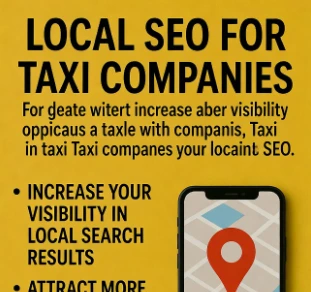
Local SEO for Taxi Companies: The Ultimate Guide to Dominating Local Searches and Boosting Bookings
In today’s fast-paced world, when someone needs a ride, they don’t browse ten websites—they open Google and type “taxi near me,” “airport taxi [city],” or “24-hour cab service.”
Local SEO for taxi companies puts your business in front of these high-intent customers exactly when they need you. Done right, it delivers more phone calls, app bookings, and repeat riders—often at a fraction of the cost of paid ads.
This comprehensive guide combines the most valuable insights from leading industry resources worldwide into one easy-to-follow resource. You’ll learn exactly how to claim the top spots in Google Maps, build trust through reviews, create conversion-focused service pages, and future-proof your visibility for AI and voice search. No more jumping between blogs—everything you need is here.
What Is Local SEO and Why Does It Matter for Taxi Companies
Local SEO is the practice of optimizing your online presence so your taxi business appears in location-based searches on Google, Google Maps, Bing, and voice assistants. Unlike traditional SEO, it focuses on proximity, relevance, and prominence in a specific geographic area.
Key statistics that prove its power for taxi businesses:
- 46% of all Google searches have local intent.
- “Near me” searches have surged over 500% in recent years.
- 88% of people who perform a local search visit a business within 24 hours.
- Customers are 70% more likely to visit and 50% more likely to buy from businesses with a fully optimized Google Business Profile.
For taxi companies, local SEO is even more critical because rides are urgent, mobile-first, and hyper-local. Riders want the fastest, most reliable option right now—not the cheapest nationwide brand. A strong local SEO strategy helps independent taxi fleets, airport transfer services, and corporate cab companies compete effectively against ride-sharing giants like Uber by highlighting local knowledge, transparent pricing, wheelchair accessibility, and 24/7 availability.
Core Components of Local SEO for Taxi Businesses
1. Google Business Profile (GBP) Optimization – Your #1 Ranking Factor
Your GBP (formerly Google My Business) is the foundation of local SEO for taxi companies. Most bookings start and end in Maps.
Essential GBP optimization steps:
- Primary category: Always select “Taxi Service” (never generic “Transportation Service”).
- Secondary categories: Add “Airport Shuttle Service,” “Limousine Service,” “Wheelchair Accessible Taxi Service,” and “Chauffeur Service.”
- Services section: Create detailed entries for every offering (e.g., “Airport Transfers – [City] to [Airport] – Fixed Price, Flight Tracking, 24/7 Availability”).
- Business description: Keyword-rich yet natural: “Reliable 24/7 taxi service in [City]. Fast airport transfers, corporate rides, and city pickups with professional drivers and clean vehicles.”
- Photos & videos: Upload 50+ high-quality, authentic images weekly—fleet exteriors, clean interiors, drivers in uniform, happy passengers, airport drop-offs. Geotag them.
- Posts: Publish 3+ times per week—promotions, travel tips, driver spotlights, holiday alerts.
- Booking links: Add direct links to your booking system or WhatsApp/Call button.
- Reviews: Aim for a steady velocity of 5-star reviews that mention reliability, cleanliness, and punctuality.
Pro tip: Use the “Location” feature to list every neighborhood, suburb, hotel, and airport you serve.
2. NAP Consistency and Local Citations
Consistency in NAP (Name, Address, Phone) across the web signals trustworthiness to Google.
- Ensure your exact business name, address (or service area), and phone number appear identically on 50+ directories (Yelp, TripAdvisor, Yellow Pages, local chambers, airport directories, etc.).
- Use tools or services to audit and fix inconsistencies.
- Build citations on transportation-specific sites and local travel blogs.
Consistent NAP improves Local Pack rankings and prevents lost calls from incorrect phone numbers.
3. High-Converting Website Optimization
Your website must turn searches into instant bookings.
Must-have elements:
- Mobile-first design with load time under 3 seconds.
- Sticky “Call Now” button and one-tap booking form above the fold.
- Dedicated service pages: /taxi-to-[airport], /24-hour-taxi-[neighborhood], /corporate-taxi-[city].
- Schema markup (LocalBusiness + TaxiService + FAQ + Review).
- Embedded Google Maps showing service area.
- Transparent pricing estimators and real-time availability indicators.
4. Keyword Research and On-Page SEO
Target these high-intent phrases:
- “Taxi near me”
- “[City] taxi service”
- “Airport taxi [City]”
- “24-hour cab [Neighborhood]”
- “Wheelchair taxi [City]”
Create unique, locally referenced content on each page (landmarks, traffic patterns, exact travel times).
5. Review Management and Trust Signals
Reviews influence both rankings and conversion rates. Respond to every review within 24 hours. Encourage post-ride feedback via SMS, vehicle QR codes, or in-app prompts.
Step-by-Step Implementation Guide for Taxi Companies
- Claim and fully optimize your Google Business Profile.
- Audit and fix all NAP citations.
- Build 10–15 hyper-local service pages.
- Implement technical SEO (speed, schema, mobile optimization).
- Launch a review collection system.
- Create monthly localized blog content.
- Earn local backlinks from hotels, airports, and tourism boards.
- Track performance weekly in Google Business Insights + Analytics.
Advanced Strategies That Separate Top Taxi Companies
- Airport Transfer Authority: Dedicated pages for every terminal with pickup instructions, flight tracking mentions, and estimated times.
- Voice & AI Search Readiness: Use natural language in FAQs and structured data so AI tools (Google Overviews, ChatGPT, Perplexity) recommend you.
- Event & Seasonal SEO: Pre-build pages for festivals, sports events, holidays, and conferences.
- Multi-location management: If you have multiple stands or hubs, create separate optimized GBPs where allowed.
Table: Top 10 GBP Optimization Tips for Taxi Businesses
TipActionImpact on Bookings
1 Correct primary category “Taxi Service”, Higher Map Pack visibility
2 Detailed Services with prices/areas, More qualified clicks
3 Weekly authentic photos & videos 2–3x higher engagement
4 Regular Google Posts Freshness signals + direct bookings
5 Add booking links, Instant conversions
6 Respond to all reviews. Builds trust & ranking boost
7 List every neighborhood served. Broader local coverage
8 Use call tracking to measure exact ROI
9 Add Q&A section: Answer common rider questions
10 Geotag all media Stronger local signals
Advantages and Disadvantages of Local SEO for Taxi Companies
Advantages:
- Cost-effective long-term traffic.
- High conversion rates (immediate need = fast bookings).
- Builds brand authority in your City.
- Competes with big apps on trust and transparency.
Disadvantages:
- Takes 3–6 months to see full results.
- Requires ongoing effort (reviews, posts, content).
- Competitive in major cities.
Twebz.com Insights and Best Practices
At Twebz.com, we specialize in helping local service businesses like taxi companies dominate their markets. Our 2026 best practices include:
- Integrate real-time fleet tracking on service pages to show “3 taxis within 5 minutes.”
- Use AI-powered review response templates that still sound personal.
- Create “Route Authority” pages that combine multiple neighborhoods and traffic data.
- Focus on zero-click optimizations so Google and AI tools display your pricing and availability directly in results.
- Combine local SEO with smart Google Ads on high-urgency terms for immediate ROI while organic rankings build.
We’ve seen clients double their Map Pack impressions and increase direct bookings by 180% within six months by following this layered approach.
Common Mistakes to Avoid
- Using only the homepage instead of service-area pages.
- Ignoring mobile speed.
- Stock photos instead of real fleet images.
- Inconsistent NAP.
- Never responding to reviews.
FAQs About Local SEO for Taxi Companies
1. How long does it take for local SEO to work for a taxi company? Most businesses see initial Map Pack movement in 4–8 weeks and significant booking increases in 3–6 months with consistent effort.
2. Is Google Business Profile enough, or do I need a website too? GBP is essential, but a fast, mobile-optimized website with service pages dramatically multiplies results and gives you full control over conversions.
3. What are the best keywords for taxi local SEO? “Taxi near me,” “[city] airport taxi,” “24 hour taxi [neighborhood],” “cab service near me,” and long-tail phrases like “affordable taxi to [landmark].”
4. How important are reviews for taxi rankings? Extremely. Recent 4–5-star reviews that mention reliability and cleanliness are among the strongest ranking factors in 2026.
5. Should I create separate pages for every neighborhood? Yes—if you genuinely serve them. Unique, valuable content for each area helps Google understand your full service radius.
6. Can local SEO help me compete with Uber? Absolutely. Highlight what apps can’t: fixed local pricing, personal driver relationships, wheelchair vans, and 24/7 human dispatch.
7. How do I track ROI from local SEO? Use Google Business Insights for calls/directions, call tracking numbers, Google Analytics goals for bookings, and monthly revenue attribution.
8. Is local SEO still effective in 2026 with AI search? More effective than ever. Clear, structured information helps AI tools recommend your business directly in answers.
Start Dominating Your Local Market Today
Local SEO for taxi companies is no longer optional—it’s the most powerful, sustainable way to grow direct bookings and reduce dependence on expensive advertising platforms.
By optimizing your Google Business Profile, building a conversion-focused website, maintaining review velocity, and creating hyper-local content, you position your taxi business as the obvious first choice whenever someone needs a reliable ride.
The companies that treat local SEO as an ongoing system—not a one-time project—will own their City’s maps and beyond.
Ready to get more calls and bookings? Implement the strategies in this guide step by step, stay consistent, and watch your taxi business thrive. Your next rider is already searching—make sure they find you first.