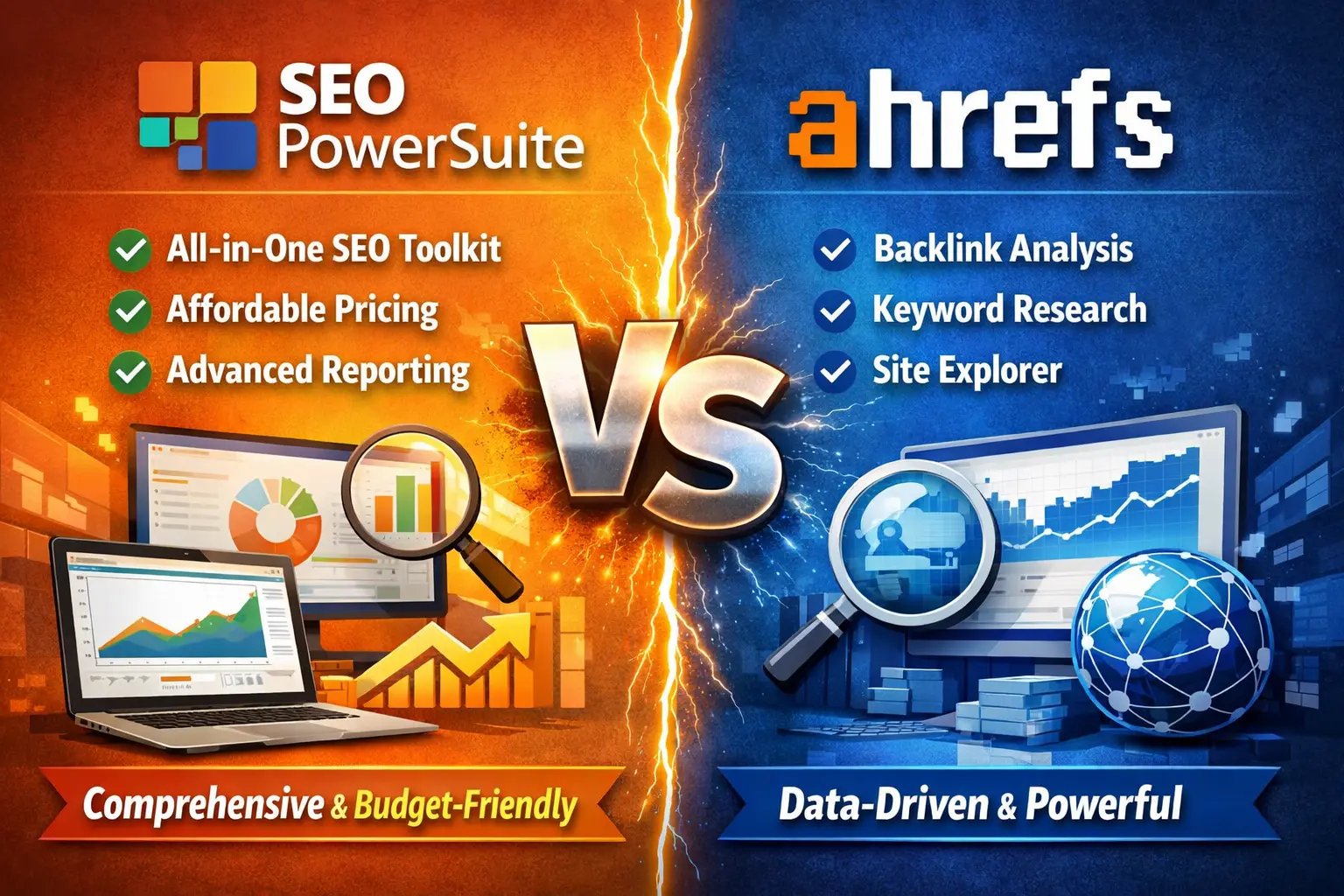
SEO PowerSuite vs. Ahrefs
SEO PowerSuite vs. Ahrefs
A ComparisonUpdated March 2026
SEO PowerSuite vs Ahrefs:
The Complete, Honest Comparison
Everything you need to choose the right SEO platform — pricing, features, real-world performance, and who each tool is actually built for.
📋 Table of Contents
- Introduction: Why This Comparison Matters
- Tool Overview: What Each Platform Is
- Pricing: The Full Picture
- Head-to-Head Feature Comparison
- Overall Scores by Category
- Desktop vs Cloud: The Core Difference
- Who Should Use Which Tool?
- 30-Day Integration Workflow
- Common Mistakes When Choosing SEO Tools
- Pro Tips for Getting Maximum Value
- Final Verdict
- FAQ (People Also Ask)
1. Introduction: Why This Comparison Matters
If you’re serious about SEO in 2026, you will eventually end up staring at two names side by side: SEO PowerSuite and Ahrefs. They both promise to do the same job — rank your site higher and beat your competitors — but they approach the problem from completely different angles, cost wildly different amounts, and are optimized for very different types of users.
The internet is full of comparison articles that recycle the same surface-level bullet points. This one goes deeper. We’ll pull apart pricing structures, database quality, real user sentiment from G2, Capterra, and Software Advice, and build a framework that lets you make the right call for your specific situation — whether you’re a solo blogger, a freelance consultant, an in-house SEO lead, or an agency managing 50 clients.
Let’s start with the basics, then go deep.
2. Tool Overview: What Each Platform Is
What Is SEO PowerSuite?
SEO PowerSuite is a desktop-based SEO toolkit developed by Link-Assistant, a company founded in 2004. Unlike the dominant SaaS trend in the industry, SEO PowerSuite runs primarily as software installed on your Windows, macOS, or Linux machine — a distinction that has major implications for pricing, data ownership, collaboration, and capability limits.
The suite consists of four integrated desktop applications:
- Rank Tracker — Keyword research, rank monitoring across 500+ search engines, mobile vs. desktop tracking, unlimited keywords
- WebSite Auditor — Technical SEO crawling, on-page analysis, internal linking visualization, content optimization
- SEO SpyGlass — Backlink discovery, competitor link analysis, toxic link identification, disavow file creation
- LinkAssistant — Link prospecting, outreach management, link-building campaign tracking
In recent years, SEO PowerSuite has evolved into a hybrid desktop + cloud model. The cloud layer handles server-side rank checks (keeping your IP hidden from Google to avoid CAPTCHAs), cloud backup of project data, and report sharing. But computation and storage remain largely on-device — which is what lets them keep costs dramatically lower than pure SaaS competitors.
What Is Ahrefs?
Ahrefs is a cloud-based SEO suite that launched in 2010 as a pure backlink analysis tool and has since grown into one of the most sophisticated all-in-one SEO platforms on the market. It operates the world’s second-most-active web crawler after Googlebot, scanning over 8 billion pages every 24 hours.
Ahrefs’ core toolset includes:
- Site Explorer — Organic traffic estimates, backlink profiles, top pages, ranking keywords
- Keywords Explorer — 28.7 billion keywords across 217 global locations and 10 search engines
- Site Audit — Technical SEO health checking with cloud crawling
- Rank Tracker — Keyword position monitoring with SERP feature tracking
- Content Explorer — Content discovery and link-building research (not available on Lite plan as of late 2025)
- Brand Radar — AI search visibility tracking across ChatGPT, Perplexity, Google AI Overviews, Gemini, and Copilot
Ahrefs’ most celebrated capability is its backlink database: over 35 trillion external backlinks refreshed every 15–30 minutes — the most frequently updated link index in the industry. It achieved $100M+ in annual recurring revenue as a bootstrapped company with roughly 50 employees.
3. Pricing: The Full Picture
This is where the two tools diverge most dramatically — and where many buyers get tripped up by surface-level comparisons.
SEO PowerSuite Pricing (2026)
SEO PowerSuite uses an annual license model — you pay once per year, not monthly. This is critical for total-cost-of-ownership calculations.
Additional notes: Multi-year plans offer up to 34% discount. After 6 months, a Search Algo Updates subscription is required to maintain full search engine connectivity and cloud features — factor this into your budget. The bundle discount (all 4 tools together) is approximately 40% off individual tool pricing.
Ahrefs Pricing (2026)
Ahrefs uses a monthly subscription model with an optional 20% annual billing discount. Plans are differentiated by credit limits, project counts, keyword tracking capacity, and user seats.
Honest Price Comparison Table
| Scenario | SEO PowerSuite Cost | Ahrefs Cost | Difference / Year |
|---|---|---|---|
| Solo practitioner, basic SEO | ~$299/yr (Professional) | $1,548/yr (Lite annual) | Save ~$1,249/yr |
| Freelancer, multiple clients | ~$499/yr (Enterprise) | $2,988/yr (Standard annual) | Save ~$2,489/yr |
| Small agency, 3-person team | ~$499/yr + licenses | $5,388/yr (Advanced annual) | Save ~$4,000–4,800/yr |
| Large agency needing deep data | May need both tools | $5,388/yr (Advanced, 3 seats) | Depends on usage |
The cost savings with SEO PowerSuite are substantial — especially for individuals and small agencies. The tradeoff: you don’t get Ahrefs’ data scale, real-time cloud access, or seamless multi-user collaboration.
4. Head-to-Head Feature Comparison
4.1 Keyword Research
Ahrefs operates one of the largest keyword databases available — 28.7 billion keywords across 217 global locations and 10 search engines including Google, YouTube, Amazon, Bing, Yandex, and Baidu. Its Keyword Difficulty (KD) score is calculated based on actual ranking page backlink data rather than simple domain metrics, making it more nuanced than competitors. The Traffic Potential metric (showing traffic the top-ranking page actually receives, not just the keyword itself) is uniquely useful for content prioritization.
SEO PowerSuite’s Rank Tracker offers 17 keyword research methods, covering keyword suggestions, related terms, competitor keywords, autocomplete results, and more. Its database of approximately 216 million keywords is far smaller than Ahrefs’ — but for many use cases (particularly targeting specific niches or local markets), the practical difference is minimal. The tool integrates with Google Search Console and Google Analytics 4 to ground keyword data in your actual performance metrics.
| Feature | SEO PowerSuite | Ahrefs | Advantage |
|---|---|---|---|
| Keyword database size | ~216 million | 28.7 billion | Ahrefs |
| Search engines covered | 500+ | 10 major | PS |
| Keyword tracking limit | Unlimited | 750–5,000 (plan-dependent) | PS |
| KD score accuracy | Good | Best-in-class (link-based) | Ahrefs |
| Traffic Potential metric | No | Yes | Ahrefs |
| YouTube/Amazon keyword data | Limited | Yes | Ahrefs |
| Local keyword tracking | Street-level precision | City-level | PS |
| GSC/GA4 integration | Yes | Yes (GA in Analytics) | Tie |
Verdict: For raw keyword database scale and research depth, Ahrefs wins. For unlimited tracking and multi-engine coverage (especially Yandex, Baidu, etc.), SEO PowerSuite has an edge.
4.2 Backlink Analysis
This is Ahrefs’ strongest domain — and the reason many SEOs subscribe to it despite its cost. The platform maintains 35+ trillion external backlinks refreshed every 15–30 minutes, discovering 10 million new pages daily and updating metrics for 300 million pages every 24 hours. No competitor matches this refresh frequency. New and lost links appear with roughly 12-hour update frequency, enabling rapid competitive response.
SEO PowerSuite’s SEO SpyGlass uses 50+ quality metrics to analyze backlinks and comes with a cloud-based backlink checker (free to try). In 2026, it’s particularly strong for checking link quality, identifying toxic patterns, and generating disavow files. The database is smaller and less frequently updated than Ahrefs, but for many agency use cases — especially toxic link audits and disavow work — it’s more than adequate.
| Feature | SEO PowerSuite | Ahrefs | Advantage |
|---|---|---|---|
| Backlink index size | Large (unspecified) | 35+ trillion links | Ahrefs |
| Data refresh rate | Regular updates | Every 15–30 minutes | Ahrefs |
| Historical data | Available | Up to 5 years (plan-dependent) | Ahrefs |
| Toxic link detection | Yes (50+ metrics) | Yes | Tie |
| Disavow file creation | Yes (built-in) | Requires manual process | PS |
| Link intersect analysis | Yes | Yes (up to 10 URLs on Standard+) | Ahrefs |
| Outreach workflow | LinkAssistant (built-in) | Separate tool needed | PS |
| Domain Rating / DR | No (uses own metrics) | Yes (0–100 scale) | Ahrefs |
4.3 Rank Tracking
SEO PowerSuite’s Rank Tracker is widely regarded as the strongest component of the suite. It allows tracking of unlimited keywords across unlimited projects with no artificial ceiling — a stark contrast to Ahrefs’ 100–5,000 keyword limits depending on plan tier. SEO PowerSuite supports daily ranking updates, mobile vs. desktop segmentation, SERP feature tracking (including Google AI Overviews as of 2026), and its distinctive street-level local rank tracking — allowing you to set rank checks from an exact address and measure how visibility changes block-by-block across a city.
Ahrefs’ Rank Tracker is clean, fast, and integrates seamlessly with its broader toolset. Real-time keyword ranking updates, SERP feature tracking, and competitor comparison are all well-executed. But its per-plan keyword limits mean scaling becomes expensive, and hyper-local precision is limited to city-level targeting.
| Feature | SEO PowerSuite | Ahrefs | Advantage |
|---|---|---|---|
| Keyword tracking limit | Unlimited | 100–5,000 (by plan) | PS |
| Local rank precision | Street-level | City-level | PS |
| Mobile vs. desktop tracking | Yes | Yes | Tie |
| AI Overview tracking | Yes (2026) | Yes (Brand Radar) | Tie |
| Historical data | 1 year (Professional) | 6 months–5 years (by plan) | Ahrefs (higher plans) |
| SERP feature tracking | Yes | Yes | Tie |
| CAPTCHA-free checks | Yes (cloud-based) | Yes (cloud-native) | Tie |
4.4 Site Audit
G2 data shows SEO PowerSuite outperforms Ahrefs on SEO auditing specifically, scoring 9.1 vs 8.7. Its WebSite Auditor crawls websites and detects over 40 types of SEO issues, checks 50+ on-page optimization factors, provides internal linking visualizations to spot orphan pages, generates white-labeled audit reports, and integrates deeply with Google Analytics 4 and Search Console for a richer picture of technical impact.
Ahrefs’ Site Audit is cloud-based, which means it’s inherently easier to schedule and share across teams — no local machine needed. It handles JavaScript rendering and provides clean summaries of health scores. However, it’s less granular than WebSite Auditor for on-page content optimization analysis.
✓ SEO PowerSuite Audit Strengths
- 40+ technical issue categories detected
- 50+ on-page SEO factor checks
- Visual site structure & internal link map
- Deep content optimization suggestions
- White-labeled client reports built-in
- No crawl credit limits
✗ SEO PowerSuite Audit Weaknesses
- Requires local machine to run crawl
- Slower for very large sites vs. cloud
- Less seamless team scheduling
- JavaScript rendering less polished
✓ Ahrefs Audit Strengths
- Cloud-based — runs without local machine
- Easy to schedule & share with teams
- Clean health score dashboard
- Good JS rendering support
- Integrates with full Ahrefs suite
✗ Ahrefs Audit Weaknesses
- Crawl credits consumed per page
- Less granular on-page optimization
- Content optimization less detailed
- Expensive to audit large sites frequently
4.5 Content Tools
Ahrefs has significantly stronger content tooling. Its Content Explorer (Standard plan and above) indexes hundreds of millions of pages, letting you discover top-performing content in any niche, find link-building opportunities, track brand mentions, and identify content gaps. The AI Content Helper assists with optimization and refinement. In 2025, Ahrefs launched Brand Radar — a pioneering tool tracking brand visibility across AI-generated answers from ChatGPT, Perplexity, Google AI Overviews, Gemini, and Copilot, with a database exceeding 100 million prompts.
SEO PowerSuite’s content tools focus on technical on-page optimization rather than content strategy. WebSite Auditor’s content analysis checks TF-IDF, semantic relevance, and page structure — useful for optimizing existing content, but it lacks the content discovery and ideation capabilities of Ahrefs Content Explorer.
4.6 Reporting & White-Label
This is a decisive win for SEO PowerSuite at the Enterprise level. Agencies need branded, client-ready PDF reports — and SEO PowerSuite’s Enterprise plan includes fully customizable white-label templates with your logo, colors, and branding. Reports can be scheduled to generate and email automatically. For agencies, this feature alone can justify the entire cost difference versus Ahrefs.
Ahrefs offers reporting within its platform (dashboards, exports, project overviews), but does not offer white-label PDF reports natively. Agencies using Ahrefs typically rely on third-party reporting tools (AgencyAnalytics, DashThis, etc.) for client deliverables — adding cost and workflow friction.
| Feature | SEO PowerSuite | Ahrefs |
|---|---|---|
| White-label PDF reports | Yes (Enterprise) | No |
| Scheduled automated reports | Yes (Enterprise) | Limited |
| Custom report templates | Yes (fully customizable) | Partial |
| Data export (CSV/SQL/HTML) | Yes (Enterprise) | Yes (credits consumed) |
| Shareable cloud dashboards | Limited | Yes |
| API access | Available | Standard+ (credits-based) |
| Client portal | Via reports | No native portal |
4.7 Local SEO
SEO PowerSuite has a meaningful advantage in hyper-local tracking. In 2026, two users standing on the same street can see different Local Pack results. SEO PowerSuite’s street-level rank tracking lets you set rank checks from an exact address, see how visibility varies across city blocks, and measure how a business’s local visibility radius expands over time as SEO improves. For local SEO agencies, this level of granularity is genuinely valuable — and unavailable in Ahrefs, which tracks at city-level resolution.
Ahrefs does support local keyword research (filtering by location), local competitor analysis via Site Explorer, and tracking local SERP features — but does not offer address-level precision for rank monitoring.
4.8 Collaboration & Team Features
This is Ahrefs’ clearest structural advantage. As a cloud platform, Ahrefs supports real-time multi-user access, shared projects, permission levels, and synchronized dashboards. Multiple team members can work simultaneously from different devices without any sync friction.
SEO PowerSuite’s desktop architecture means one concurrent user per license — a genuine constraint for teams. Projects can be backed up to the cloud and synced between machines, and licenses can be shared across devices (useful for small teams with staggered schedules), but it cannot match Ahrefs for true concurrent collaboration. The tool also cannot be accessed from a browser — requiring a software install on every work machine.
5. Overall Scores by Category
Scores below are compiled from G2, Capterra, Software Advice, and our analysis. Scale: 1–10.
🟢 SEO PowerSuite
🔵 Ahrefs
6. Desktop vs Cloud: The Core Philosophical Difference
At the heart of this comparison is a fundamental architectural decision: do you want your SEO tool to run on the cloud, or on your machine? This isn’t just a UX preference — it has real consequences for data ownership, pricing, speed, privacy, and collaboration.
| Dimension | Desktop (SEO PowerSuite) | Cloud (Ahrefs) |
|---|---|---|
| Data ownership | Stays on your machine | Stored on vendor servers |
| Data limits | None (storage = your disk) | Credits, project limits, keyword caps |
| Pricing scalability | Fixed annual cost; grows with you | Rises with usage and team size |
| Access anywhere | Requires installed machine | Any browser, any device |
| Team collaboration | Single concurrent user | Multi-user, real-time |
| Privacy / compliance | Local storage, GDPR-friendly | Data on vendor infrastructure |
| Uptime dependency | No internet needed for core tasks | Requires internet connection |
| Setup effort | Software install required | Instant browser access |
| Performance speed | Local CPU = fast large operations | Server-dependent, can queue |
For organizations with data residency requirements (healthcare, legal, government), the fact that SEO PowerSuite keeps all project data on-device is not a minor detail — it can be the deciding factor. For fully distributed remote teams, Ahrefs’ cloud-native architecture removes friction that desktop tools create.
“The desktop model trades cloud convenience for control. Teams expecting real-time, shared dashboards and true multi-user concurrency may find the handoffs and scheduling a step back — but for practitioners where margins are tight and localization matters, a desktop-first stack can be both capable and affordable.”
7. Who Should Use Which Tool?
The right tool depends on your specific constraints. Use the guide below as a starting point, not a rigid rule.
Choose SEO PowerSuite If…
You’re budget-conscious
Under $500/year for the full Enterprise suite vs. $3,000–5,400/year for comparable Ahrefs plans. The savings are real and substantial.
Local SEO is your focus
Street-level rank tracking is unmatched. If you manage local business clients and need hyper-precise location data, PowerSuite wins decisively.
You’re a client-facing agency
White-label PDF reports, custom templates, and scheduled delivery make SEO PowerSuite’s Enterprise plan a natural fit for agencies that deliver regular reports.
Data privacy matters
All project data stays on your machine. No vendor data exposure, no cloud compliance concerns — critical for regulated industries.
You track many keywords
Unlimited keyword tracking with no per-keyword billing means scaling your monitoring never increases your tool cost.
You need multi-engine coverage
Tracking rankings on Yandex, Baidu, Naver, or other non-Google engines? SEO PowerSuite supports 500+ search engines vs. Ahrefs’ 10.
Choose Ahrefs If…
Backlink analysis is central
35+ trillion links updated every 15–30 minutes. For link building, competitive link research, and real-time monitoring, Ahrefs is unmatched.
You have a team
Multiple SEOs need simultaneous access? Ahrefs’ cloud architecture with shared projects and permissions removes collaboration friction.
Data scale is critical
28.7 billion keywords, 217 locations, 456 billion indexed pages. For enterprise-grade competitive research, Ahrefs’ dataset is simply larger.
You need AI search visibility
Brand Radar tracks your presence in ChatGPT, Perplexity, and Google AI Overviews — critical as AI search captures more queries.
You work across devices
Browser-based access from any device, any location. No software installs, no sync issues — critical for mobile-first or remote workflows.
Content strategy is priority
Content Explorer, content gap analysis, and AI Content Helper make Ahrefs a stronger platform for data-driven content ideation and strategy.
When to Use Both Together
Many professional SEOs use a hybrid approach: Ahrefs for competitive market intelligence (backlink research, keyword gap analysis, content ideation) and SEO PowerSuite for ongoing operations (unlimited rank tracking, white-label reporting, local precision, technical audits). At SEO PowerSuite’s ~$499/year vs. Ahrefs’ Standard at $2,988/year, combining them can still cost less than Ahrefs Advanced alone.
8. 30-Day Integration Workflow
Whether you’re switching tools or evaluating for the first time, here’s a practical framework for getting both platforms working optimally.
Week 1: Discovery & Baseline
- Set up your primary project in SEO PowerSuite Rank Tracker with all target keywords
- Run initial WebSite Auditor crawl; export issues list
- In Ahrefs Site Explorer, benchmark your domain’s DR, referring domains, and top pages
- Use Ahrefs Keywords Explorer to identify 20–30 high-value targets you may have missed
Week 2: Competitive Research
- Use Ahrefs Link Intersect to find domains linking to competitors but not you
- Export competitor keyword rankings from Ahrefs Content Gap tool
- Analyze competitor backlink velocity and anchor text in Ahrefs Site Explorer
- In SEO SpyGlass, deep-dive the backlink profiles of 3 competitors with toxic link analysis
Week 3: Execution
- Fix top-priority technical issues found in WebSite Auditor (prioritize crawl errors, broken links, duplicate content)
- Create content briefs based on Ahrefs content gap analysis
- Begin link prospecting in SEO PowerSuite’s LinkAssistant using competitor backlink data
- Set up automated rank tracking in PowerSuite (daily/weekly schedules)
Week 4: Reporting & Iteration
- Generate white-label client report from SEO PowerSuite Enterprise
- Review ranking movements in Rank Tracker; identify quick-win opportunities
- Use Ahrefs Rank Tracker for SERP volatility monitoring on key pages
- Schedule next crawl in WebSite Auditor to verify fixes are live
9. Common Mistakes When Choosing SEO Tools
- Comparing monthly prices, not annual total cost of ownership. SEO PowerSuite’s $499/year vs. Ahrefs’ $3,000–5,400/year looks very different when written as annual figures.
- Ignoring credit limits in Ahrefs. New users often underestimate how quickly credits are consumed by exports, expanded rows, and frequent searches — leading to unexpected plan upgrades.
- Choosing tools before defining your actual use cases. The “best” tool is the one that serves your specific daily workflow — not the one with the highest G2 score.
- Overlooking the collaboration requirement. Solo practitioners often overpay for cloud collaboration features they never use. Teams often underbuy and discover limitations later.
- Ignoring reporting capabilities for agencies. If you need branded client reports, SEO PowerSuite’s white-label PDFs eliminate a significant workflow step and tool cost.
- Treating SEO PowerSuite as “basic.” It’s a professional-grade tool favored by experienced SEOs — its desktop nature does not make it less capable than Ahrefs for most tasks.
- Treating Ahrefs as the automatic winner. Recent price increases, credit restrictions, and a no-refund policy have made Ahrefs genuinely difficult to justify at lower tiers.
- Not testing the free tiers before committing. SEO PowerSuite has a permanent free plan. Ahrefs has Webmaster Tools (for your own site) and a $29 Starter. Use them first.
10. Pro Tips for Getting Maximum Value
SEO PowerSuite Pro Tips
- Use the PowerSuite Cloud to sync between machines. Great for small teams where one person works desktop and another is remote — export/import project files via cloud backup.
- Set up scheduled tasks for automated rank checks and reports. On the Professional/Enterprise plan, you can run tasks overnight and wake up to fresh data and scheduled reports.
- Import Ahrefs keyword exports into Rank Tracker. Use Ahrefs for keyword discovery, then track those keywords unlimited in PowerSuite for zero ongoing cost.
- Use LinkAssistant’s email outreach templates. Most users don’t fully explore the outreach workflow — it can replace a standalone outreach tool like Pitchbox or BuzzStream for small agencies.
- Leverage multi-year pricing. A 2-year or 3-year plan can save up to 34% vs. annual pricing — significant when the base cost is already low.
Ahrefs Pro Tips
- Use batch analysis strategically. On Standard and above, batch analysis lets you check metrics for hundreds of URLs simultaneously — use this for content audits and link prospecting, as it’s more credit-efficient than individual lookups.
- Master the Traffic Potential metric over search volume. Traffic Potential shows what the top-ranking page actually gets — often 3–10x the search volume of the seed keyword. This reveals true opportunity size.
- Set up new backlink alerts for competitors. Real-time new link alerts are one of the most actionable features in Ahrefs — they let you identify and intercept link-building opportunities as soon as a competitor earns them.
- Use Content Explorer’s “published” filter to find linkable asset opportunities. Filter for pages published in the last 30 days with high referring domains to spot trending topics that still have link-building momentum.
- Pay annually — the 20% discount is meaningful at these price points. On Standard ($249/mo → $2,388/yr vs $2,988/yr), annual billing saves $600 per year.
11. Final Verdict
Neither tool is universally “better.” The right answer is a function of your budget, workflow, team structure, and SEO priorities.
✅ Choose SEO PowerSuite When:
- Budget is a primary constraint
- You need unlimited keyword tracking
- White-label client reporting is required
- Local SEO with street-level precision matters
- Data privacy or residency is important
- You track rankings on non-Google engines
- You’re a solo practitioner or small agency
- You want deep site audit + on-page tools
✅ Choose Ahrefs When:
- Backlink intelligence is mission-critical
- Your team needs concurrent cloud access
- Data scale for enterprise research matters
- Content strategy and discovery are priorities
- AI search visibility tracking is needed
- Budget is not the primary constraint
- You operate fully remote or across devices
- Deep historical data is required
SEO PowerSuite Overall
The most underestimated value in professional SEO software. Its desktop architecture, which looks like a weakness to many buyers, is actually its superpower: no arbitrary data limits, no per-seat SaaS fees, no credit anxiety. For agencies delivering client reports, local SEO practitioners, and anyone managing a large keyword set on a reasonable budget, SEO PowerSuite at ~$499/year is among the best software investments in the SEO industry.
Best for: Solo SEOs · Local agencies · Budget-conscious teams · Report-heavy workflows
Ahrefs Overall
Still the gold standard for backlink analysis and competitive intelligence — its 35 trillion link database with 15–30 minute refresh is genuinely unmatched. Content Explorer, Brand Radar for AI search, and seamless cloud collaboration make it the right choice for teams prioritizing data scale and modern search landscape readiness. Recent price increases and the credit system make it harder to justify at lower tiers, but for Standard+ users extracting daily value, the ROI is clear.
Best for: Link builders · Content teams · Distributed agencies · Enterprise SEO
12. FAQ — People Also Ask
Is SEO PowerSuite as good as Ahrefs?
It depends on what “good” means to you. SEO PowerSuite is better than Ahrefs for rank tracking (unlimited keywords, street-level local), white-label reporting, value per dollar, and data privacy. Ahrefs is better for backlink database scale and freshness, keyword research breadth, content tools, and team collaboration. For many real-world SEO workflows, SEO PowerSuite is not just “as good” — it’s the superior choice.
Why is SEO PowerSuite so much cheaper than Ahrefs?
SEO PowerSuite processes most data locally on your machine rather than on expensive cloud infrastructure. This dramatically reduces the vendor’s operating costs, savings they pass to customers. Ahrefs operates one of the world’s most active web crawlers with cloud infrastructure serving millions of queries — costs that are baked into their pricing. The price gap is architectural, not a signal of quality difference.
Can SEO PowerSuite replace Ahrefs?
For many use cases, yes. If your workflow centers on rank tracking, technical audits, on-page optimization, link building outreach, and client reporting, SEO PowerSuite can fully replace Ahrefs. Where it cannot replace Ahrefs is for real-time competitive backlink intelligence (Ahrefs’ 15-30 min refresh has no equivalent), large-scale keyword database research, and simultaneous team collaboration.
Does SEO PowerSuite have a free version?
Yes. SEO PowerSuite offers a permanent free plan that includes access to all four tools (Rank Tracker, WebSite Auditor, SEO SpyGlass, and LinkAssistant) with limited functionality — you cannot save projects or schedule tasks, but you can fully explore the feature set before committing to a paid plan. This is a stronger free offer than Ahrefs, which has no traditional free trial.
Is Ahrefs worth the price in 2026?
For teams using it daily and extracting value from its full toolset (particularly backlink analysis, Content Explorer, and competitive intelligence), yes. For light or occasional users, the cost is difficult to justify — especially at Lite ($129/month) where Content Explorer is no longer included and credits are tightly rationed. The April 2024 price increases reduced perceived value at entry tiers; Standard ($249/month) is where Ahrefs becomes a genuine daily-use tool.
What is the main disadvantage of SEO PowerSuite?
The main disadvantage is its desktop-first architecture, which creates two real limitations: (1) no simultaneous multi-user access — only one person can actively use a license at a time, making it challenging for larger teams; and (2) requires software installation on each work machine, meaning you cannot access your projects from any browser. For fully remote or distributed teams, this is a genuine workflow constraint.
Which SEO tool is best for agencies?
It depends on agency size and structure. Small agencies (1–3 SEOs) typically find SEO PowerSuite Enterprise at ~$499/year to be exceptional value — unlimited keywords, white-label PDF reports, and full audit capabilities at a fraction of cloud alternatives. Mid-to-large agencies (4+ concurrent users) often lean toward Ahrefs for its shared cloud access and data scale. Many agencies use both: Ahrefs for competitive research and client audits, PowerSuite for ongoing rank tracking and deliverables.
Does Ahrefs track AI search visibility (ChatGPT, Perplexity)?
Yes. Ahrefs launched Brand Radar in 2025, which tracks brand mentions across AI-generated answers from ChatGPT, Perplexity, Google AI Overviews, Gemini, and Copilot. With over 100 million prompts in its database, this is one of the most advanced AI search monitoring tools available in any SEO platform. SEO PowerSuite has added Google AI Overview tracking to its rank monitoring, but does not have equivalent AI search intelligence coverage.
What is the best alternative to Ahrefs?
The best alternative depends on your primary need. For budget-conscious all-in-one SEO: SEO PowerSuite ($299–499/year). For an all-in-one cloud suite with PPC data: Semrush ($139–$499/month). For a mid-range cloud option: SE Ranking ($55–$200/month). For focused backlink data at lower cost: Majestic ($50–$400/month). For beginners or small businesses: Mangools ($29–$79/month).
Can I use SEO PowerSuite and Ahrefs together?
Absolutely — and many experienced SEOs recommend this approach. Use Ahrefs for keyword discovery, competitive backlink research, and content gap analysis. Then import those insights into SEO PowerSuite for ongoing unlimited rank tracking, deep technical audits, and white-label client reporting. The combined annual cost is often still lower than Ahrefs Standard alone, making this hybrid approach compelling for freelancers and small agencies.